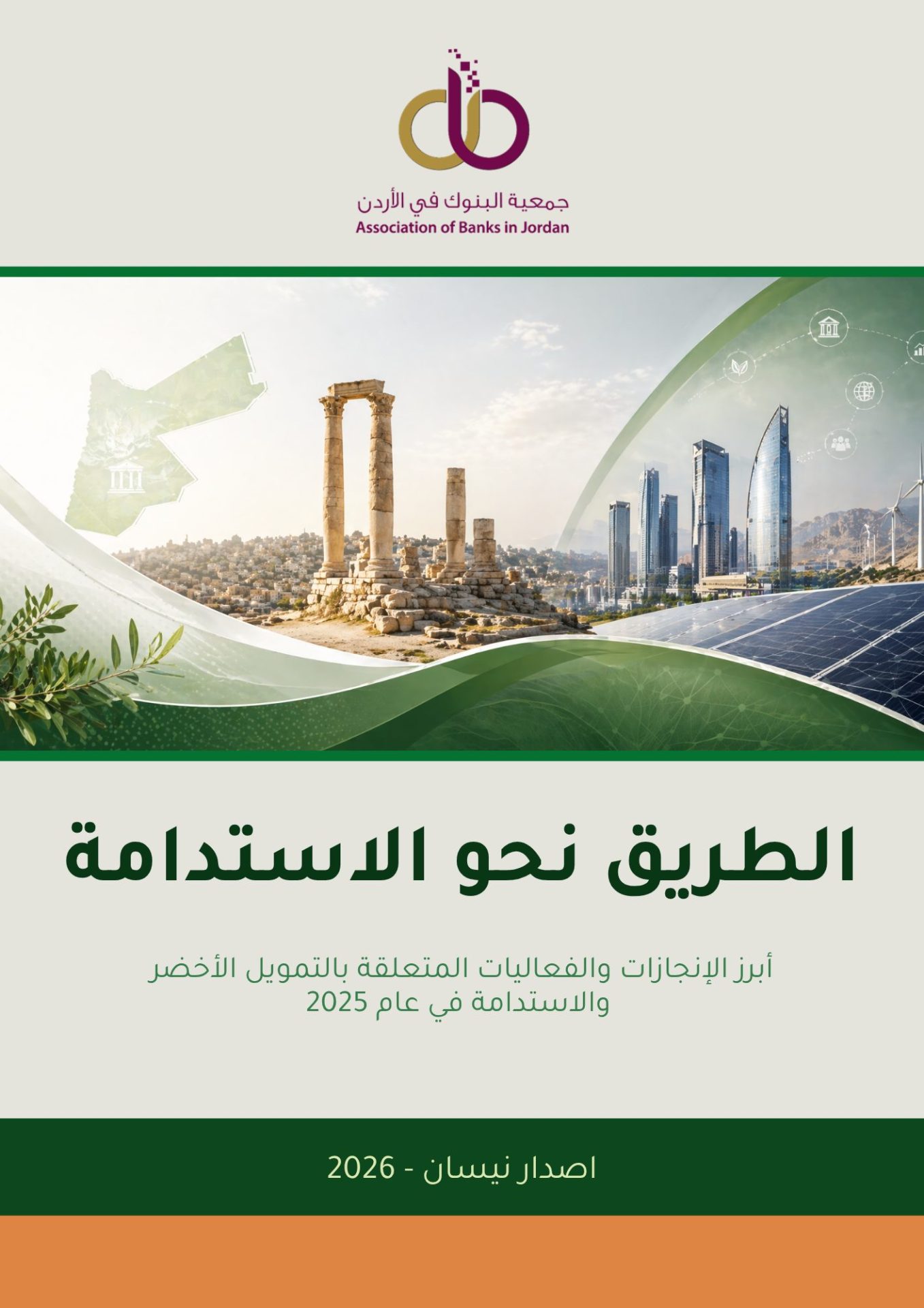




The Association of Banks in Jordan has issued its report titled “Major Banking Developments for 2024,” which includes a wide range of data, information, and banking indicators related to banks operating in Jordan—both at the aggregate and individual levels. The report reflects the strength of the banking sector and its continued growth and stability. It provides accurate data and indicators based on figures published by the Central Bank of Jordan and the banks operating in the Kingdom.
The report presents a positive picture of the Jordanian banking sector’s performance during 2024, showing stable growth in key financial indicators—evidence of its resilience and ongoing ability to support the national economy despite regional and global challenges. Total assets of banks operating in Jordan rose by 5.6%, reaching JD 69.85 billion. This growth was driven by a 5.2% increase in domestic assets to JD 63.05 billion, and a 9.3% rise in foreign assets to JD 6.8 billion. Bank assets represented 184.4% of GDP at current prices, reflecting the sector’s central role in financing economic activity and ensuring liquidity for growth.
In parallel, the report showed a notable rise in total bank deposits in Jordan during 2024, increasing by 6.8% to reach approximately JD 46.7 billion. This increase resulted from growth in both private- and public-sector deposits. Deposits of all types—demand, savings, and time deposits—rose during the year. These figures indicate the sustained confidence in Jordan’s banking institutions and the strong, stable relationship between banks and their individual and corporate clients.
According to the report, total credit facilities granted by licensed banks increased by 4.2%, reaching JD 34.78 billion by the end of 2024, underscoring the sector’s ongoing role in stimulating economic activity. Loans and advances accounted for 60.3% of total facilities, followed by Islamic banks’ receivables at 29.9%, and overdrafts at 8.2%. By currency, 87.6% of total facilities were in Jordanian dinars, with 12.4% in foreign currencies.
From a sectoral perspective, four key economic sectors accounted for about two-thirds of total credit facilities: construction (22.6%), services and public utilities (17.2%), general trade (16.2%), and industry (11.1%). Certain sectors experienced significant growth, with facilities to general trade increasing by 16.5% and to services and utilities by 9.2%.
The report also highlighted the continued growth of retail banking services. In 2024, banks in Jordan issued over 191,000 credit cards of various types and granted more than 136,000 personal loans totaling JD 1.08 billion. Additionally, around 33,100 housing and real estate loans were issued, amounting to JD 867.5 million, while car loans reached 49,000, totaling JD 629 million. The expansion of individual lending and financing reflects banks’ efforts to promote financial inclusion and improve access to financial services.
Financial soundness indicators demonstrated the stability of Jordan’s banking system. Non-performing loans (NPLs) stood at 5.6%, within internationally safe levels, reflecting the high quality of bank credit portfolios. The coverage ratio reached 74.5%, leaving only 6.1% of NPLs uncovered. The capital adequacy ratio stood at 18%, exceeding both Central Bank of Jordan and Basel Committee requirements. The legal liquidity ratio reached 144.7%, comfortably above the minimum required level of 100%. Return on assets was 1.1%, and return on equity was 9.1%, reflecting stable profitability and sustained operational efficiency in the sector.
In terms of gender distribution among individual clients of banks operating in Jordan, the report showed that male depositors accounted for 63.2% of total depositors, while females represented 36.8%. Male deposits constituted 71.8% of total individual deposits, compared to 28.2% for females. Male borrowers accounted for 76.5% of total individual borrowers, while female borrowers represented 23.5%. Male loans represented 79.1% of the total value of individual loans, compared to 20.9% for females.
Regarding the geographic distribution of banks within the Kingdom, the report indicated that by the end of 2024, there were 869 branches, 53 offices, and 2,365 ATMs.
The report also reviewed the performance of banks listed on the Amman Stock Exchange, including stock price indices, trading volumes, and non-Jordanian ownership in Jordanian banks. It examined the structure of interest rates on deposits and facilities, the interest rate margin, and developments in monetary policy tools. The report also detailed new banking services introduced by banks in Jordan during 2024.
Furthermore, the report highlighted major developments in electronic payment systems. Both the eFAWATEERcom and CliQ systems expanded significantly, accompanied by growth in the number of e-wallets and linked financial accounts, as well as an increase in the number and value of transactions conducted through internet banking, mobile banking, and point-of-sale systems. Banks also introduced several new digital banking services that enhance digital transformation and improve customer experience.
In the area of human resources, the report recorded an increase in the number of employees in Jordan’s banking sector, reaching 22,996 by the end of 2024. Banks continued to invest in training and professional development, with hundreds of employees participating in specialized training courses during the year. Female participation in the banking workforce rose to become one of the highest among Jordan’s economic sectors.
The Major Banking Developments for 2024 report expanded significantly compared with the 2023 edition in terms of content, analysis, and data. New sections and tables were added to reflect the latest developments in the Jordanian banking sector, with a stronger focus on digital transformation, innovative banking services, and updated statistical indicators.
Overall, the report presents a clear and comprehensive picture of the strong performance of banks operating in Jordan and underscores their contribution to economic and social development. It also affirms that the Jordanian banking sector enters 2025 with a solid financial foundation, robust liquidity and capital structures, and a clear strategy to promote digital innovation and expand financial inclusion—strengthening Jordan’s position as a leading financial and banking hub in the Arab region.